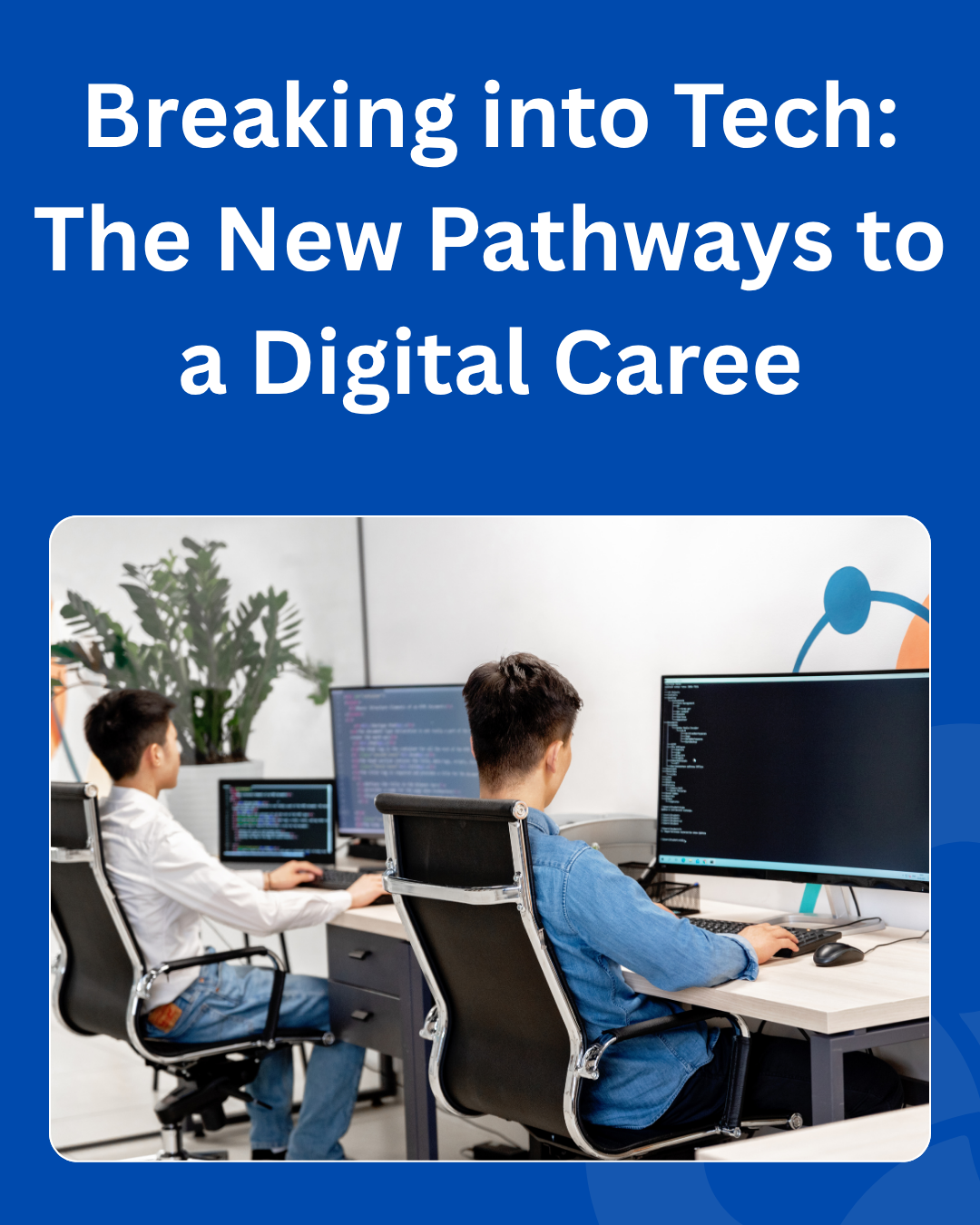
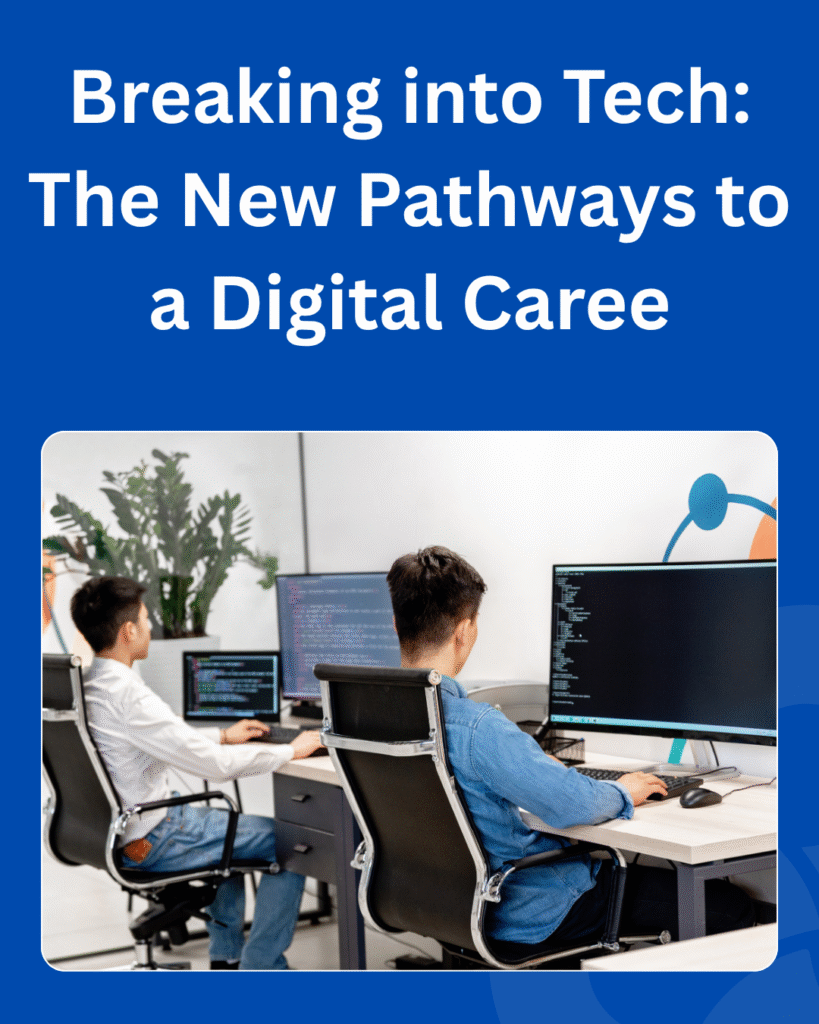
Breaking into Tech: The New Pathways to a Digital Career
Introduction: The Great Digital Shift
The technological transformation of the 21st century is a defining feature of the century that is changing people’s lives, working conditions, and socializing manners.Breaking into Tech: The New Pathways to a Digital Caree. Technology is considered a foundation of every other sector and no longer a separate industry, starting with smartphones and cloud computing and going all the way to artificial intelligence (AI) and blockchain. In this constantly changing environment, one can witness daily disruptions in traditional career paths and the emergence of new digital opportunities.
For many, “breaking into tech” was synonymous with a computer science degree or a coding background. Well, that is not the case anymore. The digital economy has opened up access to tech careers for everyone professing the same characteristics, namely: curiosity, dedication, and the right mindset. Be they online learners, bootcampers, remote workers, freelancers, or entrepreneurs, all have one and the same path — the tech world.
This article is meant to highlight the new ways of getting into tech while discussing how modern education, skills development, community engagement, and digital innovation are all playing a part in changing the way people get into technology careers.
1. Understanding the Modern Tech Landscape
To v into tech successfully, it’s essential to first understand what “tech” really means today.Breaking into Tech: The New Pathways to a Digital Caree. Technology is not limited to software engineers and data scientists — it extends into almost every profession and industry.
Tvech careers now span across:
Software and App Development — creating products, tools, and platforms.
Data Science and Analytics — turning data into actionable insights.
Cybersecurity — protecting digital systems and information.
UI/UX Design — enhancing user experiences through creativity and empathy.
Cloud Computing and DevOps — building and managing digital infrastructure.
AI and Machine Lear
2. The Death of the Traditional Career Path
In the earlier days, entering a profession was always through a one-way road: getting a degree, applying for jobs, and eventually reaching the top. Breaking into Tech: The New Pathways to a Digital Caree. But tech is slowly breaking that mold.
Digital professionals today are their own teachers, very adaptable, and they consider learning as a lifetime process. The road to success for a lot of developers, designers, and analysts started with non-tech professions—such as journalists with coding skills, artists turned UI designers, teachers going for data analysis, or marketers with automation tools for mass communication.
Tech industry usually consider the result, not the resume as the major factor for rewarding. v. Formal education does not guarantee your portfolio, GitHub repositories, personal websites, and project showcases may weigh more than that.
Such a scenario has encouraged the emergence of new paths like:
– Online learning platforms such as Coursera, Udemy, edX, and freeCodeCamp.
– Coding bootcamps that provide immersive and job-ready training.
– Tech companies’ apprenticeship and internship programs.
– Community-driven learning through open-source collaboration and hackathons.
In fact, technology has made career mobility practically unlimited. No matter if you are 18 or 45, if you have the will and the right method, switching to tech is doable.
3. Online Learning: The Gateway to Digital Skills
One of the most powerful transformations in the digital world is the availability of online education. Breaking into Tech: The New Pathways to a Digital Caree. In former times, acquiring technical knowledge meant that one had to go and enroll in a university course. Now, you can learn almost any skill you want from your computer—usually for free or at a very low cost.
Popular Learning Platforms
– Coursera and edX—give access to top university courses and professional certificates from the most reputable institutions.
– Udemy and Skillshare—emphasize on the practical, hands-on approach to learning for both beginners and professionals.
– freeCodeCamp and The Odin Project—offer training in full-stack web development.
4. Bootcamps and Accelerated Learning Programs
Bootcamps give an intensive, immersive experience for quickly tech people.
General Assembly, Le Wagon, Flatiron School, and Springboard are some of the bootcamps that provide structured programs with a focus on practical, job-ready training.Breaking into Tech: The New Pathways to a Digital Caree. Most bootcamps provide mentorship, real-world projects, and placement support as part of their program.
These programs have become increasingly popular to career changers — people going from non-tech fields to digital roles. Many bootcamps even provide deferred tuition plans that allow students to pay after getting a job only.
Bootcamps are also places where students can learn from each other and network with other techies — and this can be as valuable as the technical content itself. Working together mimics the real workplace and boosts the skills of teamwork.
5. Networking and Community: The Hidden Key to Success
In the IT industry, knowing the right people can be as crucial as your knowledge. Breaking into Tech: The New Pathways to a Digital Caree. Networking is a good way to know about hidden jobs, find mentors and get into partnerships.
How to Build Your Tech Network
Participate in online communities such as GitHub, Stack Overflow, Reddit tech forums, and Discord groups.
Be present at tech meetups (local and online), conferences, or hackathons.
Take part in open-source projects, which can really help you to get experience, visibility, and recognition as a developer.
Set up a professional LinkedIn profile where you can talk about the ups and downs of your learning journey and showcase your projects.
Community engagement is named by many successful people as the turning point in their tech careers. Collaborating and sharing learning experiences is always more powerful than isolating and learning alone.
6. The Rise of Freelancing and Remote Work
The global shift toward remote and freelance work has completely changed how tech professionals build careers. Platforms like Upwork, Fiverr, and Toptal have opened global markets for skilled workers.
Freelancers can now work for companies around the world without leaving home.Breaking into Tech: The New Pathways to a Digital Caree. This flexibility benefits both sides: businesses gain access to a diverse talent pool, and individuals can design careers aligned with their lifestyle and goals.
Remote work also pushes professionals to develop self-management and communication skills, which are increasingly valuable in distributed teams.
For many, freelancing becomes a gateway to full-time tech roles, entrepreneurship, or passive income streams through products like apps, templates, and digital tools.
Non-Traditional Entry Routes: Apprenticeships, Fellowships, and Internships
7.
The tech industry is gradually shifting its focus towards the candidates’ skills rather than their education background and hence some companies are already introducing such programs— internships and fellowships —that will allow the newcomers to gain hands-on experience.
Some of the major ones are:
Elevate with Google Career Certificates and Apprenticeship Programs.
Microsoft LEAP for new developer talents list.
IBM SkillsBuild along with Amazon Technical Apprenticeships.
Through these programs, the mixing of the learning and the world of the actual experience has been so good that the participants are able to move unbelievably fast into permanent positions. Apart from that, they also get the support of mentors, form new connections and have the chance to experience the company’s culture-all of which are very important for growing one’s career.
The Power of Personal Branding
8.
In the already packed online job market, personal branding is way more than just a prominent personality. Talent hunters frequently stumble upon professionals’ working online portfolios, blogs, and social media profiles.
Tech Brand Building
Develop your personal website which will consist of your portfolio, projects, and achievements.
Create content like blogs or tutorials based on your learnings.
Acknowledge and keep your presence on LinkedIn, Twitter (X), or Medium.
Be a part of the open-source or community projects and let others know it’s you.
Your brand reveals your professional journey not only through the facts of what you do, but also through how you think, learn, and create. Breaking into Tech: The New Pathways to a Digital Caree. Visibility has to be through consistent means, that way you will be attracting the job offers rather than applying for them all the time.
9. The Role of Mentorship in Breaking into Tech
If a mentor is present, then the tech career will be very much expedited. Mentors steer the ship through the rough waters of the tech industry by being there to give advice, support, and sharing their views. Furthermore, they are able to make you realize your mistake, guide you to reach your destination, and open the doors for you.
From Women Who Code to CodeNewbie and ADPList, the different tech communities offer various mentoring schemes. Breaking into Tech: The New Pathways to a Digital Caree. The same can be said about the informal mentorship that takes place via LinkedIn or local groups, which can lead to significant changes.
A good mentor not only transfers technical skills but also imparts the knowledge of career navigating strategies such as salary negotiation, personal development, and work-life balance.
10. Emerging Fields: Where the Opportunities Are
Tech is more accessible if you go with the flow of developing sectors. Today’s most promising areas include:
Artificial Intelligence and Machine Learning — boosting automation, analytics and innovation.
Cybersecurity — securing businesses from rising digital porosity.
Cloud Engineering and DevOps — creating infrastructure which is capable of expansion.
Data Analytics and Visualization — changing raw data into useful information.
Blockchain and Web3 — making it possible to share and own digital assets.
Internet of Things (IoT) — making devices and systems smartly interconnected.
Product Design (UI/UX) — taming the wilds of creativity through usability.
Every field has various user-friendly ways for beginners through which they can get involved like taking certification courses, participating in open-source projects, and being part of community challenges.
11. Overcoming Barriers: Diversity and Inclusion in Tech
On the one hand, there has been a noticeable progress on the issue of diversity, equity, and inclusion in tech; on the other hand, it still remains a challenge. v. More specifically, women, minorities, and people from low-income backgrounds are among the underrepresented groups that continue to experience barriers.
In contrast to that, the companies and programs like Girls Who Code, Black Girls Code, TechUp and ReDI School are breaking the proverbial ice.
12. Building a Career Growth Mindset
Getting into tech is not just one-time success, it is the start of a lifetime of continual learning. The most successful tech workers are those who take always on their heels and practice a growth mindset: curiosity, a smooth change of plan, and an open mind to learning throughout life.
Tips for Long-Term Growth
Never stop learning — the technology sector is always up to something.Breaking into Tech: The New Pathways to a Digital Caree. Every year, new tools and languages are released.
Request feedback — teachers, fellow workers, and bosses are the ones from whom you should get feedback.
Keep yourself informed — read tech online journals and newsletters, and listen to podcasts.
Develop grit — there is a lesson in every error.
The tech world is constantly changing; if you can change with it then you have the best asset.
13. From Entry-Level to Expert: Building Experience
Finding the first job or getting hired for a project is often the toughest moment in the whole process.Breaking into Tech: The New Pathways to a Digital Caree. But after you are in, you will be adding up to your experience with every engagement.
There are some ways to build your credibility rapidly:
Do small freelance or volunteer projects.
Be part of open-source communities.
Keep a record of everything e.g. case studies, coding snippets, the methods adopted in problem-solving, etc.
Always and continuously think of improvement of your work and thus your skills.
After a few years, the experience you have, even if it is from non-traditional ways, can add up to or even exceed the one from formal education.
14. The Entrepreneurial Path: Creating Your Own Opportunities
Not everyone who moves into tech sees it as a way to get a good job. The digital world has made it possible for people to start up tech-based companies—apps, SaaS products, e-commerce stores, or even consulting services.
No-code and low-code platforms nowadays allow even those who do not know anything about programming to develop their own tools and to start new businesses. Breaking into Tech: The New Pathways to a Digital Caree. Along with the advantages of entrepreneurship like freedom and financial independence, there are problems as well, the main ones being: creativeness, risk-taking, and toughness.
Many of the tech entrepreneurs started very small — either they were addressing a small issue or they were automating a daily task—but then they eventually built very successful businesses around their ideas.
15. The Future of Work: Lifelong Learning in the Digital Era
The work future will be a mixture of different locations, and it will be automated as well as tech-savvy. Breaking into Tech: The New Pathways to a Digital Caree. The technology will not only change but the people who micro do the job will be forced to change too.
The introduction of AI and robots to the work environment will see some employees losing their jobs, but importantly they will also lead to the creation of new job positions — workers who will be a hybrid between technical skill and human traits like creativity, ethics, and compassion.
The coming professionals will be required to be digital polymaths mastering various skills, which will be a mixture of coding, communication, design, and critical thinking.
As the project-based and global nature of work rises, the ability to modify one’s style of working will determine one’s success in the career over the job titles.Breaking into Tech: The New Pathways to a Digital Caree.
Conclusion: Your Pathway Begins Now
The entrance to the tech industry is no longer confined to Ivy League degrees or connections in Silicon Valley. It is rather driven by one’s interest, determination, and learning. The necessary resources are within reach, the supportive networks are active, and the chances are everywhere across the world.
No matter if you choose to learn Python online, enroll in a bootcamp, work as a freelancer from home, or create your own app — all your actions contribute to the narrative of your digital career.
The great thing about today’s technology world is that there is no one right way — only the way of making progress.
If you are open-minded about learning, flexible in your approach, and willing to network, the digital future will be yours to take. The only thing to consider is:
Are you ready to penetrate?